
From the founder
Music found me first.
Now I want to help it find someone else.
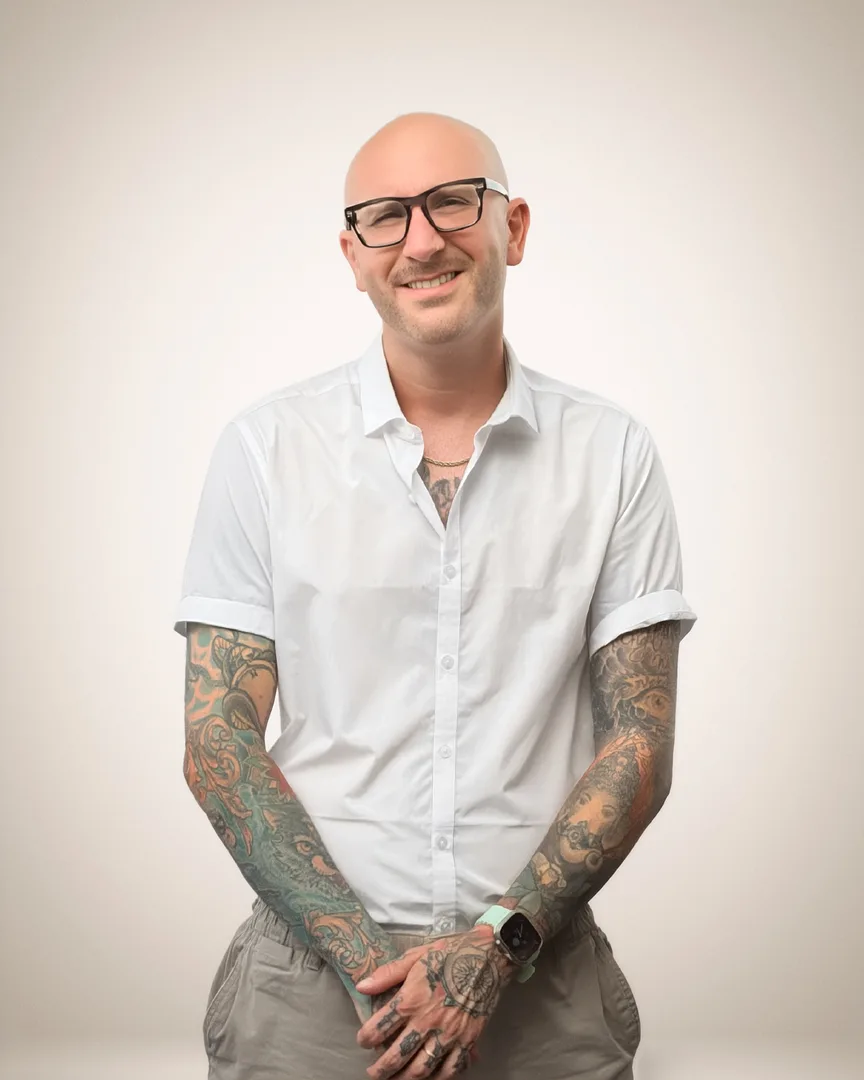
You have to hear this.
I’ve said that to a lot of people. Usually I’m already holding my phone out, already turning it up, and already a little too excited about a part that doesn’t happen until two minutes in. Sometimes it’s a whole album. Sometimes it’s a three-second drum fill that means we’re starting the song over. Twice.
I want to tell you why that moment matters so much to me, and why I’m building an organization around it.
01 What music gave me
I grew up around addiction and mental health crises. The adults who were supposed to be steady often weren’t, and from a young age I saw more than a kid is built to handle. People say that kind of thing makes you grow up fast. It did, just not the way they mean. I wasn’t emotionally mature. I was aware. I watched how the people around me were coping, or not coping, with adult life, and I learned to read a room long before I could read much else.
That awareness comes with some useful skills. It also comes with alarms that don’t switch off just because you get older. I’ve been an adult, self-sufficient and safe, for a long time now. My nervous system didn’t get the memo right away. The responses that protected me as a kid kept firing long after I needed them, and most of the time I didn’t even notice they were running. A lot of us call that anxiety. A lot of us also pass it down without meaning to, because the people who raised us didn’t have the tools to hand us anything different, and neither did the people who raised them.
The Listening Project comes from wanting to break that cycle, and from the one thing that has always helped me do it.
Music got to me before I had words for what I was feeling. I didn’t have a regulated system yet, or any real way of processing what was going on around me, but a song could make me feel something and give it somewhere to go. At first it was the lyrics. Somebody on a record was saying the thing I couldn’t. Later it turned into something bigger. It pushed me to write: journals, poetry, songs, and the little lines I still jot down and carry around with me for years.
For the record, the path went like this. Backstreet Boys first. I’m not taking questions. Then New York hip-hop. Then Aerosmith, my first concert, at Jones Beach. Then I got angry, the way teenagers are supposed to, and found punk and counterculture music, which led me to post-hardcore, emo and metalcore. Those were the golden years. I still listen to those records every single day, and I still perform them at full volume in my car, a venue with excellent attendance and very poor sound isolation.
Somewhere along the way I got curious about why music does what it does. Why one chord change feels like hope and another feels like dread. Why a part can push against the one before it and leave you hanging until it resolves. Why something can sound bright and spooky at the same time. I went to Full Sail and got a bachelor’s degree in recording arts, which is a very official way of saying I paid a lot of money (still paying, thanks for asking) to learn why your car stereo sounds like that. Along the way I studied music history and learned how a song gets built from the inside. What surprised me is that the feeling has a structure, and hearing the structure makes the feeling hit harder.
I also figured out that I’m not unusual. I feel music intensely, but I think a lot more people do than realize it. They just haven’t had anyone slow the record down and point at what’s happening. Most of us don’t know that the song we love borrowed its drums from a record made before we were born, or that a sound we think is new has been handed down through five decades of kids in bedrooms and basements. That’s an inheritance too. It’s just a good one.
Here’s the part I keep coming back to. When an artist makes something, it’s often their own therapy. Then they put it out, and it stops being only theirs. The listener takes it and makes it mean something the artist never planned. That’s what happened to me. People who never knew my name made records, and those records found a kid who had nowhere else to put what he was carrying. They got me through. They became my dialogue. Eventually I started making music myself, and the whole thing had a chance to start over with someone else.
So there are two cycles here. One gets handed down and hurts people. The other gets handed down and helps them. I want to spend this part of my life on the second one.
02 The room I want to build
That’s what The Listening Project is. We put people in a room with a great sound system and someone who knows the record inside and out, and we listen closely. We talk about how it was made, what was happening in the world around it, and who deserves credit: the writers, the players, the engineers, the person who designed the cover. Then we leave room for what it means to you.
Nobody has to share anything. Nobody gets put on the spot. In my experience the music does the opening up on its own, and at some point you look over and realize the person next to you felt exactly what you did. That’s usually when the conversation starts.
I want kids bringing in music the adults have never heard and teaching us something. I want someone who bought a record in 1972 explaining what it meant to them, sitting next to a teenager who found it on a playlist last week. Some nights will be a real study of a song and the moment that produced it. Other nights it’ll just be good music and good company. Both count.
I also want this rooted in well-being, and I want to do that carefully. We’ll develop programs alongside educators, licensed counselors and music therapy professionals. We aren’t offering treatment or medical advice. We’re building something designed by people qualified to design it, so more people can get to it.
And I want to say this plainly, because I live here. It’s easy to look at Wellen Park or Lakewood Ranch or downtown Sarasota and assume everybody’s fine. Household income doesn’t tell you what’s happening behind closed doors. A lot of us were raised by people who never got the tools either, and now we’re all on our phones, moving fast, never stopping long enough to notice what we’re carrying. We will absolutely bring in kids and adults from communities with fewer resources, and every program will hold seats for people who can’t afford a ticket. But this need doesn’t stop at any zip code.
I have two boys, and this is where they’re growing up. Most of what I wrote above about cycles, I think about when I’m with them. I’m not going to get everything right as a dad. Nobody does. But I can make sure they grow up knowing their feelings are allowed to be loud, and that a song is a good place to put them. I want their friends to have that too, and honestly, their friends’ parents. That’s a big part of why I’m building this here.
03 The road that brought me here
I’ve been doing some version of this for a long time. Before any of it, I was a theater kid, in musical theater through my teens and all of high school, which probably explains a lot. Right after high school I moved to Orlando for school, and what came after college was, let’s say, a wild ride. I was DJing and producing, playing some of Florida’s most legendary clubs, like Firestone Live in Orlando and Mecca in Miami, and festival stages alongside people who were my idols at the time, like Flux Pavilion and Flosstradamus. I saw some things in green rooms that I’ll leave out of a letter my kids might read. Mostly I was just grateful to be in the building.
What I didn’t realize then was that I was getting a second education. Almost all of it ran on a very low budget, so I learned how to build a crew, put on an event, promote it and make a night feel bigger than the money behind it. For the 17 years since I landed in Orlando, I’ve been enmeshed in progressively bigger roles organizing and building grassroots organizations that bring culture to people through live, shared experiences.
That path led me into the arts and nonprofits, and over the last 12 years it has covered just about every seat in the house. I’ve been on stage as a performer and behind the board running tech and AV. I’ve built out how events and programs actually come together, from the first idea to the last cable coiled. And eventually I landed at the director level, in strategic planning, governance and operations, leading teams and answering for high-stakes projects that generous people paid for. Now I get to bring that same care to a project my own community can call its own.
I’ve spent a lot of those years in the control room, the part of the night nobody sees. I love that room. It’s also dark, and after enough years in there I realized it gets a little lonely. Now I want to be out here, sharing these experiences with real people in real life, whether or not they know yet that they want it. (They do.)
04 Where we go from here
So we’re not going to rush this. We’ll start with a few pilot programs, pay close attention to who comes back and why, and let the people in the room tell us what this should become.
I can’t do this alone, and I don’t want to. I’m looking for the people who will make these first programs real. Educators and clinicians who want to help design them. Collectors and musicians with something to share. Venues and local businesses willing to give them a home. And anyone who has ever held their phone out and said “you have to hear this.” If that’s you, write to me. I want to hear what you’d bring.
Thanks for reading this far. Now go put something on. Loud.

If any of this sounds like you, whether you want to listen, guide a program, host one or help build the whole thing, I’d love to hear from you.
If you’re carrying something heavy right now, you don’t have to carry it alone. In the US, call or text 988 any time.